Table of Content
- Rules
- T-Mobile Little League® Home Run Derby Local Little League Host Release
- Finalists Set for 2021 T-Mobile Little League® Home Run Derby in Williamsport
- T-Mobile Little League® Home Run Derby Champions to be Revealed During Virtual Awards Show on December 9
- Little League home run
- T-Mobile Little League® Home Run Derby
Use of an illegal bat will result in disqualification of the participant from the competition. Bats that have cracks or sharp edges, or that cannot pass through the approved Little League bat ring for the appropriate division must be removed from play. Only chartered Little Leagues are eligible to host a local competition. Prince Fielder won the derby with five home runs in the first round, eleven home runs in the second round, and twelve runs in the finals. His twelve home runs in the final round ties Robinson Canó's record for final round home runs, set in 2011. Fielder beat Toronto outfielder José Bautista in the final round, 12–7.
It shall be a smooth, rounded stick and made of wood or a material tested and proved acceptable to Little League standards. The bat shall be no more than 33 inches in length, not more than two and one-quarter (2¼) inches in diameter, and if wood, not less than fifteen-sixteenth (15/16) inches in diameter (7/8 inch for bats less than 30 inches) at its smallest part. In order to be eligible to advance to a regional competition, the participant must have won their local competition. Appropriate adjustments must be made for softball e.g., using softballs and square screens for pitchers.
Rules
The Local Host acknowledges and agrees to follow all rules, regulations, and guidelines set forth in the T-Mobile Little League Home Run Derby Rules. The earliest known media account using the term "Little League home run" was a game recap written by Jeff Prugh, California Angels beat writer for Los Angeles Times, in reference to a Little League home run hit by Denny Doyle versus the Detroit Tigers on June 1, 1974. The earliest known Little League home run discovered to date was made by Ty Cobb of the Detroit Tigers versus the Cleveland Naps on September 10, 1911, nearly 28 years before the actual Little League organization itself was founded and available to lend its name to such a play.
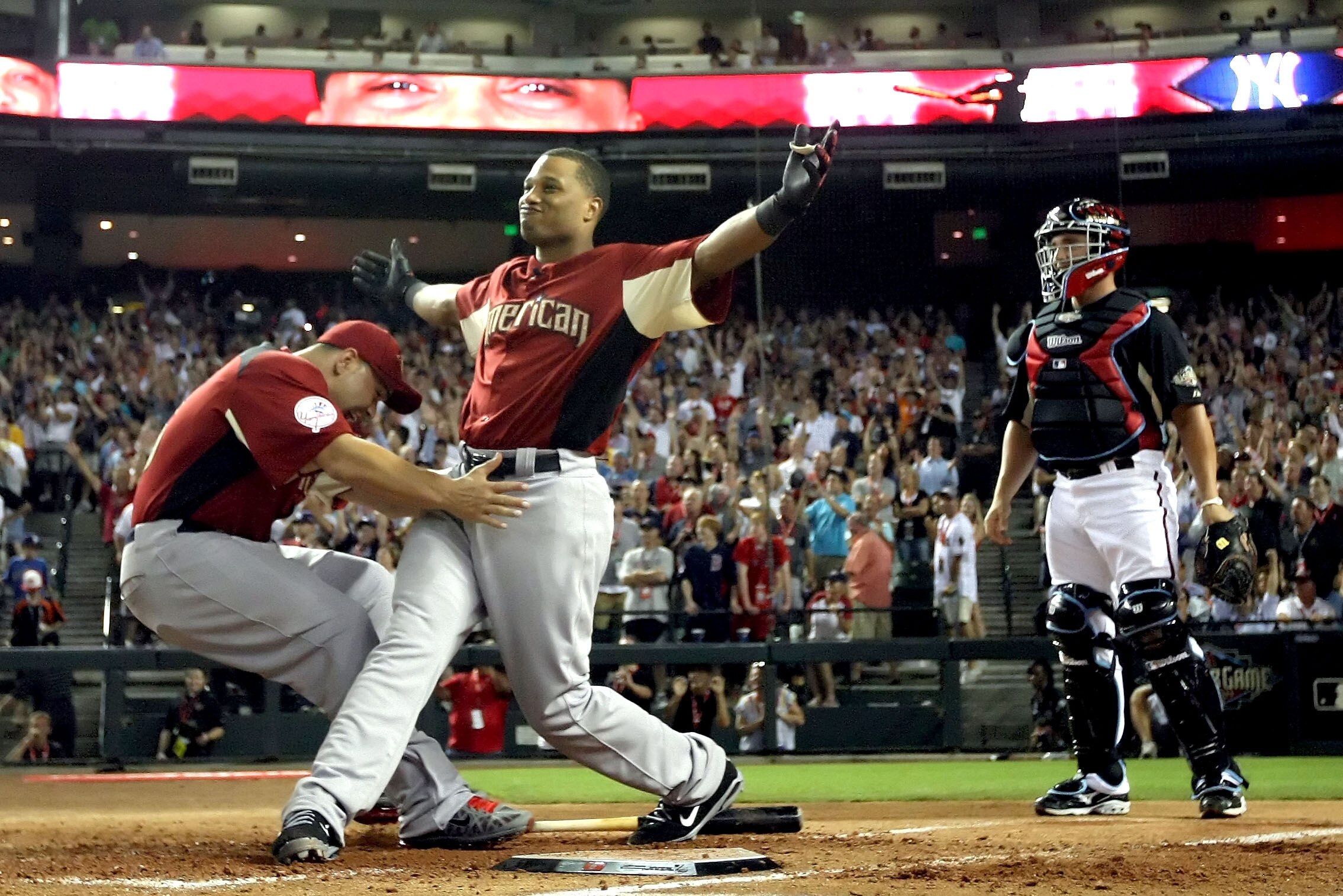
Batting order will be determined by total Home Runs hit in first and second rounds with the lowest total number hitting first. A square screen or catch net can be used in place of a catcher. All Home Run Derby Local Little League Hosts must agree to comply with the following before registering1) all of the T-Mobile Little League Home Run Derby Rules and Regulations; 2) Terms & Conditions; 3) Privacy Policy; and 4) will collect and ensure submission of all required releases and event documents. The Softball competition is limited to female athletes league age 9 – 12 years old. The Baseball competition is open to athletes league age 9 – 12 years old. Batting order will be determined by number of Home Runs hit in first round with the lowest total number hitting first.
T-Mobile Little League® Home Run Derby Local Little League Host Release
If the certification mark/s on a bat are not legible, that bat cannot be used and shall be removed from competition.
The Local Host of the local T-Mobile Home Run Derby competition must determine an appropriate way to include league age eligible participants in accordance with the Little League mission. A square screen is recommended behind second base, manned by an adult, to gather all baseballs or softballs. The Local Little League Host must further certify that they are fully eligible to enroll their league in this competition as a member of the local league Board of Directors. If the local league takes insurance coverage locally and not through the national Little League insurance coverage through AIG, the local host must have verified with their local insurance carrier and can confirm that insurance coverage will be in effect for the T-Mobile Little League Home Run Derby. If there are any ties based on local competition results, a random lottery system will be used and conducted by the Competition Agency (Position Sports, Inc.).
Finalists Set for 2021 T-Mobile Little League® Home Run Derby in Williamsport
In the event of a tie at the end of the first, second, or final round, there will be a swing-off between the participants who are tied that will determine which participant advance or wins . Each participant will receive three additional swings at a time, the contestant with the most home runs after the three additional swings will advance or be crowned the champion. The first known effort to catalogue and report on incidences of Little League home runs at the major league level was undertaken by Chuck Hildebrandt, who presented his research to the annual conference of the Society of American Baseball Research in Chicago, Illinois on June 27, 2015. The original definition of the Little League home run, as announced during the presentation, was any play during which the batter scores; and two or more errors are committed by the fielding team, regardless as to whether the batter reaches base by way of error or base hit.

In a swing-off, each tied player gets five swings to hit as many home runs as possible. If after the five swings a tie still remains, players get three more swings to determine the winner; if needed, sudden-death swings continue until one player homers. Home runs hit during a first round swing-off do not count towards the player's total going into the second round.
Jayson Veit wins Little League Home Run Derby
The term stems from Little League Baseball, founded in 1939 as an organizing body for local youth baseball and softball leagues throughout the United States and the rest of the world. Equipment donations including baseballs and/or softballs, and buckets will be released to participating leagues only if event results and photo of event winner are submitted via online portal while supplies last. As of the close of the 2017 major league baseball season, a total of 358 Little League home runs have been discovered to have occurred during the 163,081 games that are available for play-by-play query in the Retrosheet database, or roughly one LLHR for every 455 games available. These plays are all consistent with the revised 2017 definition as described above, and have been all confirmed either through contemporary newspaper accounts, or by video or audio clips from the broadcasts of the games during which they occurred. In the first two rounds, home run totals will carry over for those rounds. Should there be a tie after either of the first two rounds, a "swing-off" takes place.
This definition was established to allow queries to be run against a database of major league games for which play-by-play narrative is available, as maintained by Retrosheet. A Little League home run is a play in baseball during which a batter scores a run during their plate appearance with the aid of one or more errors committed by the fielding team. It is so called because the play is presumably evocative of how young children in the process of learning how to play the sport frequently commit fielding and throwing errors that allow batters to take more bases than they might otherwise normally take on the batted ball put into play.
For the Regional Finals and Championship, there will be a separate set of rules & regulations that will be released prior to the events taking place. The Local Host of the local T-Mobile Home Run Derby competition is responsible for setting the date, time, and location of their local competition. Helmets must have a non-glare surface and cannot be mirror-like in nature. Each helmet must meet NOCSAE specifications and bear the NOCSAE stamp as well as an exterior warning label as noted above.Warning! Manufacturers have advised that altering helmets in any way can be dangerous.Altering the helmet in any form, including painting or adding decals may void the helmet warranty. Helmets may not be re-painted and may not contain tape or re-applied decals unless approved in writing by the helmet manufacturer or authorized dealer.
All eight players participate in the first round; the four highest totals from round one will move to the semi-finals. The players with top two totals will face off in the finals, with the scores reset from the first two rounds. In the event of termination, cancellation or postponement of the Event, a notice will be posted on the Event website and no Event Entity shall be held liable in connection therewith. ASSUMPTION OF RISK OF PERSONAL/BODILY INJURY AND/OR PROPERTY LOSS/DAMAGE. I fully understand that hosting the Event involves inherent risks and dangers of accidents, personal and bodily injury and property loss or damage, and severe social and economic losses. These may result from my own actions or inactions or negligence, as well as the actions or inactions or negligence of others, the rules of play, and the condition of the facilities and equipment or vehicles. Further, there may be other risks not known to me and that are not reasonably foreseeable at this time.


No comments:
Post a Comment